
ARTICLE · AXLE CAPACITY · 4 MIN READ
Two Axles. Enough Capacity? The 120% Question.
Why axle, wheel and tyre ratings deserve closer attention on trailers with non-load-sharing suspension.
Two axles. Four tyres. Component ratings that appear comfortably above the trailer’s declared mass.
At first glance, the capacity question may look settled.
But adding the ratings together can miss an important requirement. For certain trailer configurations, the suspension arrangement brings an additional capacity condition into the assessment.
That can turn an apparently straightforward specification into a question the manufacturer or importer needs to resolve.
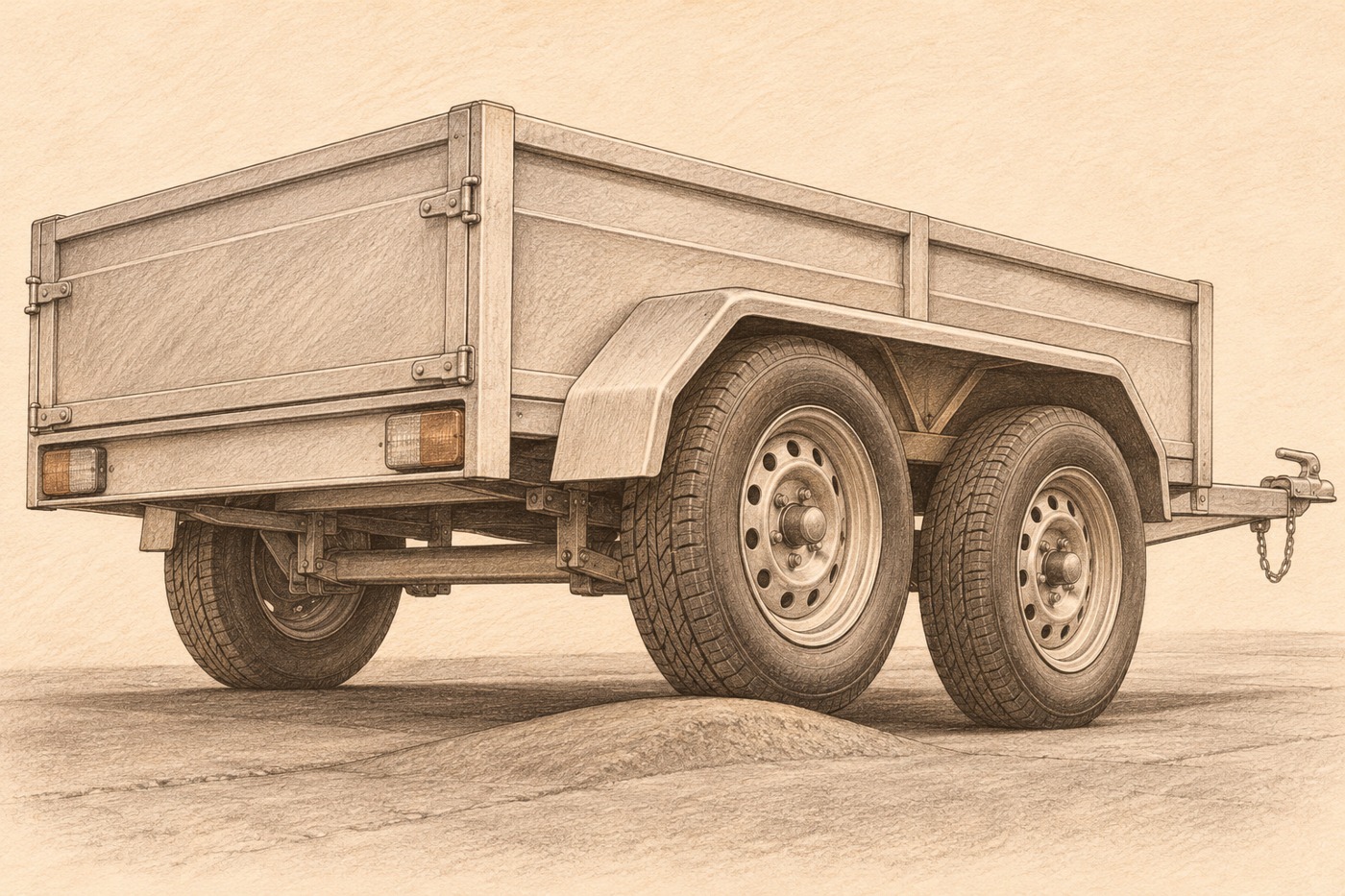
The suspension arrangement changes the question
Having more than one axle does not, by itself, establish that the suspension shares load between them.
As wheels move over uneven surfaces, the suspension arrangement affects how the load is distributed. The relevant Australian requirements distinguish load-sharing suspension from particular close-coupled arrangements that may use non-load-sharing suspension.
For manufacturers and importers, the starting point is understanding the actual configuration—not relying on the description “tandem axle”.
What does the 120% requirement relate to?
For the relevant close-coupled axle-group exception on trailers below 4.5 tonnes ATM, ADR 43/04 requires capacity of at least 120% of the nominal load imposed on each axle with the trailer at its ATM. The condition covers the axle itself and the wheels and tyres fitted to it. Read the primary ADR wording.
The reference is therefore the nominal load on each axle—not simply the trailer’s total ATM.
The trailer’s ATM and GTM, coupling loading and laden axle distribution need a consistent basis. Dividing ATM by the number of axles does not automatically establish that basis.
The additional capacity requirement is not permission to carry an extra 20% payload or increase the trailer’s declared ratings.
The axle plate is only part of the picture
An axle rating deserves attention, but it does not establish the capacity of every component fitted around it.
The wheel/rim specification and tyre ratings also matter. Their capacities need to be considered for the actual arrangement on each axle. A higher-rated tyre does not establish a higher-rated wheel or axle.
VSB 1 addresses the 120% condition in its axles and suspension guidance and separately requires suitable wheel and tyre specifications. See VSB 1, Chapters 11–12.
The practical question is whether the supporting information covers the combination being supplied.
A familiar product still needs relevant evidence
A recognised brand, an overseas approval or a catalogue entry can be useful information. The next question is what that information establishes about the exact assembly, its application and the completed trailer.
A general statement that a component has survived a severe test does not, on its own, explain its load-carrying capacity under the relevant requirement.
Resolving uncertainty may require manufacturer clarification or specialist engineering input. That is a different task from collecting a photograph of a plate.
Resolve it while there are still choices
For a proposed purchase, investigate before the specification is locked in or the trailer is shipped.
For an existing product range, consider whether the records clearly support the axle, wheel and tyre combinations currently being supplied.
Discovering an evidence gap later can mean further enquiries, engineering review, component changes or delays. The appropriate response depends on the actual configuration and evidence.
Let ROVER Pro help establish the position
ROVER Pro helps manufacturers and importers identify the relevant compliance questions, review supporting information and coordinate the assistance needed to resolve gaps.
Before relying on the numbers on the plates, let us help establish whether the evidence supports the trailer behind them.
Discuss your trailer configuration with ROVER Pro.
Unfamiliar terminology? Search our Glossary, Abbreviations and Definitions.
General information focused on relevant close-coupled, non-load-sharing axle arrangements on trailers below 4.5 tonnes ATM. Other configurations, retractable-axle arrangements and applicability questions require separate assessment. This Article does not establish the compliance or capacity of a particular trailer.